

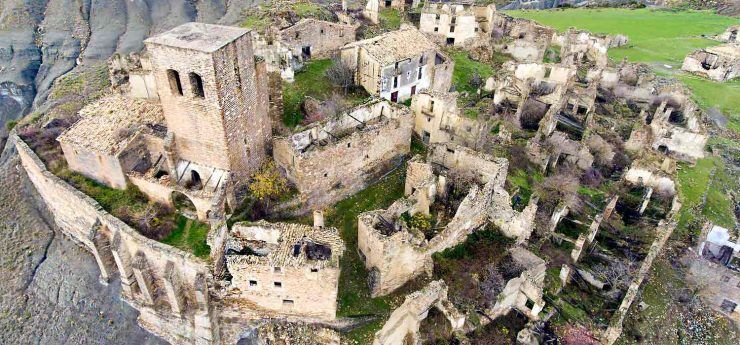
Esco, or Escó as it is known by the residents of the Zaragoza region of Jacetania, has been practically an abandoned village since it was expropriated in the 1960s for the construction of the Yesa Reservoir. Only one of its houses is inhabited by four neighbors, and not on a permanent basis.
History of Esco
Esco is located near the first foothills of the Pyrenees, and it is undoubtedly a village that will fascinate lovers of abandoned places—those towns that hold a story often lost to time. Abandoned villages carry a special, ghostly charm full of mystery. Walking through its streets, one cannot help but wonder where the life that once thrived in its corners has gone.

The history of Esco is long and rich. Its origins date back to the time before the Roman conquest in the 1st century BC when the area was already inhabited by the Jacetans and Vascones. By the 6th century BC, Celts from present-day Belgium, the Suessetani, settled there.
After the Roman presence, Esco gained strategic importance during the Middle Ages, having its own castle built by order of Peter II of Aragon in the early 13th century.
In the mid-19th century, Madoz, the author of the popular Geographical, Statistical, and Historical Dictionary of Spain, visited the town, noting that it had around 250 inhabitants at that time. A century later, the construction of the Yesa Dam led to its gradual abandonment.
What to see in Esco
Among the ghostly streets of Esco, the ruins of the Romanesque Church of San Miguel stand out, as well as the reconstructed Hermitage of Nuestra Señora de las Viñas. A stroll among its bare windows and crumbling walls feels somewhat apocalyptic.

The locality belongs to the Ebro Hydrographic Confederation, which has systematically denied requests from the Pro Reconstruction Association of Esco to reverse the town’s progressive degradation and restore its habitability. Although it is part of the Camino de Santiago and is declared a Historical-Artistic Site, neither public nor private sectors have provided any solutions for rehabilitating this small architectural gem of Aragon.

Location of the abandoned Village of Esco, Zaragoza
The village of Esco is located on the southern side of the Sierra de Leyre, on the border between Zaragoza and Navarra. Its only access route is the N-240 road, between Liédena and Berdún.
In conclusion, if you are traveling through the province of Zaragoza or nearby Navarra and have some time to spare, do not miss the chance to visit the abandoned village of Esco—a sad but still beautiful representation of the deep issue known as “Empty Spain” that threatens to erase some of our most precious cultural heritage.










Add comment